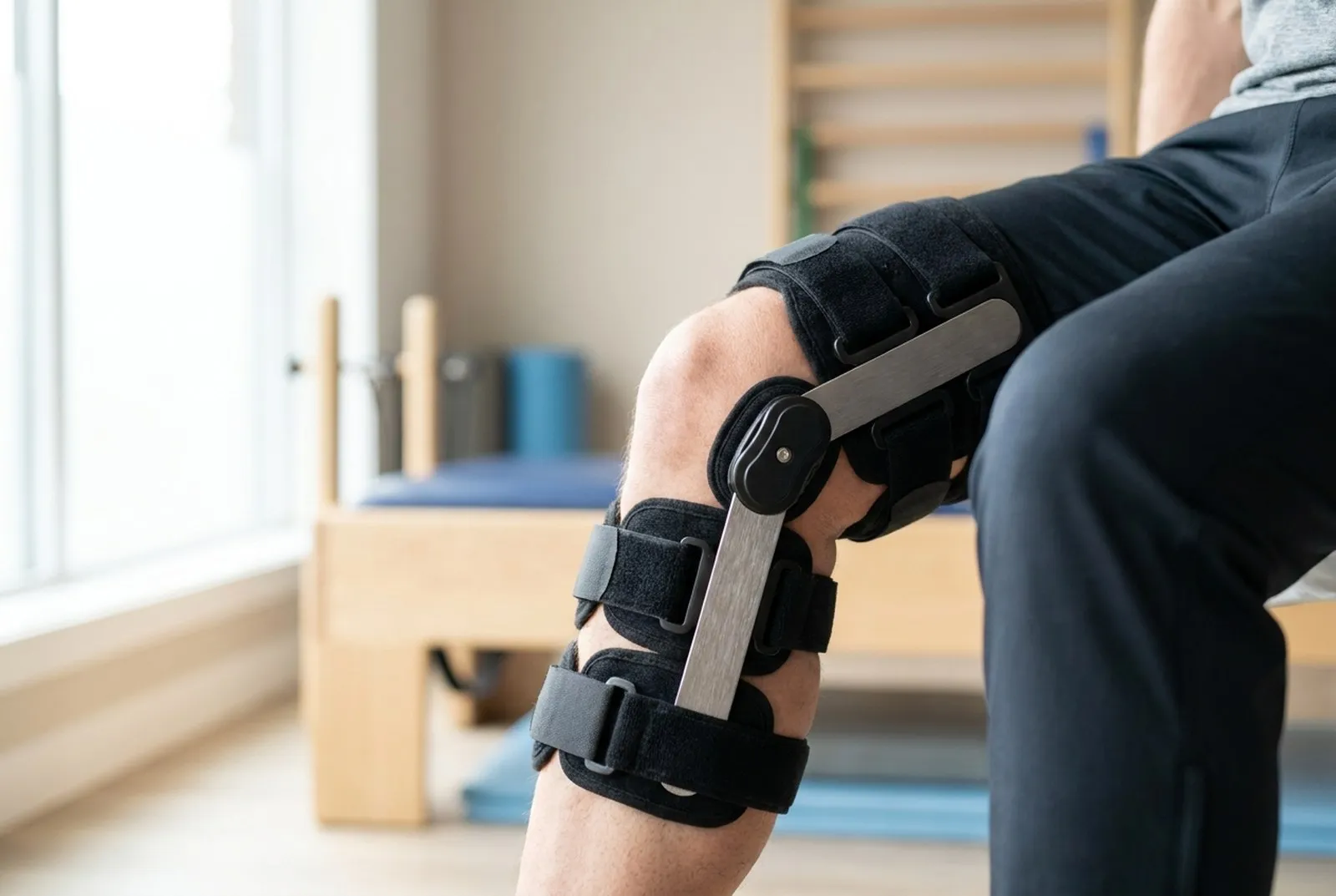
Best Knee Braces for Meniscus Tears (2026) — Top Picks
Can a knee brace help a meniscus tear? Compare hinged, wraparound, and sleeve braces for support and comfort, learn how to choose, and see our top picks for torn-meniscus support — a buyer's guide, not medical advice.

McDavid Knee Brace, Maximum Support with Polycentric Hinges & Cross Straps, Comfortable Compression & Extra Stability
Polycentric hinges and cross straps give collateral and rotational support for moderate-to-severe tears and a return to activity.
- Bilateral geared polycentric hinges
- Cross straps add compression and medial/lateral stability
- Open 360-degree padded buttress around the kneecap
- Perforated back panel; fits left or right knee
$77.99Price as of Nov 6, 2026, 14:38 UTC
As an Amazon Associate, BestKneePad earns from qualifying purchases.
Check Price on AmazonQuick picks
McDavid Knee Brace, Maximum Support with Polycentric Hinges & Cross Straps, Comfortable Compression & Extra Stability
Polycentric hinges and cross straps give collateral and rotational support for moderate-to-severe tears and a return to activity.
$77.99Price as of Nov 6, 2026, 14:38 UTC

Shock Doctor Knee Brace, Compression Knee Brace for Men & Women, Hinged Knee Brace with Side Stabilizers, Maximum Support, Adjustable Dual Hinges
Heavy-duty bilateral hinges and side stabilizers in a pre-curved, four-way-stretch Lycra mesh sleeve — a reliable mid-price hinged choice.
$66.99Price as of Nov 6, 2026, 14:38 UTC

Mueller 597069 Hg80 Premium Hinged Knee Brace
Mueller's triaxial hinge is designed to closely simulate the natural tracking of the knee joint.
$79.99Price as of Nov 6, 2026, 14:38 UTC

BraceAbility Torn Meniscus ROM Knee Brace - Hinged Post Surgery Support with Flexion Extension Control for Hyperextension and Locking Treatment, Ligament PCL or ACL Tears, Osteoarthritis
Polycentric range-of-motion hinges with flexion and extension control, sized from petite to plus-size — for clinician-specified motion limits.
$59.99Price as of Nov 6, 2026, 14:38 UTC

DonJoy Clima-Flex OsteoArthritis OA Knee Brace – Arthritis Knee Wrap Cooling, Offloading, Compression Relieves Mild to Moderate Knee Pain
An offloading OA wrap in breathable C-6 fabric with keyless on-the-fly hinge adjustment to tune the offload — the pick for the OA-plus-meniscus overlap, where unloader evidence is strongest.
$245.99Price as of Nov 6, 2026, 14:38 UTC
Compare Top Knee Braces for Meniscus Tears (2026) — Top Picks
Side-by-side specs, ratings, and where to buy.
| Image | Rank | Product | Best For | Rating | Verdict | Where to buy |
|---|---|---|---|---|---|---|
| | 1 | McDavid McDavid Knee Brace, Maximum Support with Polycentric Hinges & Cross Straps, Comfortable Compression & Extra Stability | best polycentric hinge meniscus | Bilateral geared polycentric hinges | $77.99Price as of Nov 6, 2026, 14:38 UTC | |
| | 2 | Shock Doctor Shock Doctor Knee Brace, Compression Knee Brace for Men & Women, Hinged Knee Brace with Side Stabilizers, Maximum Support, Adjustable Dual Hinges | best hinged allrounder meniscus | Heavy-duty bilateral dual hinges with side stabilizers | $66.99Price as of Nov 6, 2026, 14:38 UTC | |
| | 3 | Mueller Mueller 597069 Hg80 Premium Hinged Knee Brace | best breathable hinged meniscus | Triaxial hinge designed to closely simulate natural knee tracking | $79.99Price as of Nov 6, 2026, 14:38 UTC | |
| | 4 | BraceAbility BraceAbility Torn Meniscus ROM Knee Brace - Hinged Post Surgery Support with Flexion Extension Control for Hyperextension and Locking Treatment, Ligament PCL or ACL Tears, Osteoarthritis | best postop rom meniscus | Polycentric range-of-motion hinges with aluminum stays | $59.99Price as of Nov 6, 2026, 14:38 UTC | |
 | 5 | EXOUS BodyGear EXOUS BODYGEAR Knee Brace For Women & Men For Arthritis Acl, Mcl Pain Patented 4-way Adjustable Wraparound Support Dual Side Stabilizer For Patella Stability | best adjustable wraparound meniscus | Patented 4-strap system | $34.98Price as of Nov 6, 2026, 14:38 UTC | |
 | 6 | Mueller MUELLER Sports Medicine Self Adjusting Hinged Knee Brace for Men and Women, Knee Stabilizer for Compression and Pain Relief Support, Ideal for Arthritis, Sprains, One Size | best budget hinged meniscus | Biaxial hinges, one on each side | $21.97Price as of Nov 6, 2026, 14:38 UTC | |
 | 7 | Bauerfeind Bauerfeind - GenuTrain - Knee Brace - Targeted Support for Pain Relief and Stabilization of The Knee, Provides Relief of Weak, Swollen, and Injured Knees | best compression knit meniscus | Medical-grade gradient compression | $99.90Price as of Nov 6, 2026, 14:38 UTC | |
 | 8 | Modvel Modvel Compression Knee Brace for Women & Men, 2-Pack Knee Brace for Running Knee Pain, Knee Support Compression Sleeve, Workout Sports Knee Braces for Meniscus Tear, ACL & Arthritis Pain Relief | best budget sleeve meniscus | Slip-on compression sleeve, nylon and latex blend | $24.99Price as of Nov 6, 2026, 14:38 UTC | |
| | 9 | DonJoy DonJoy Clima-Flex OsteoArthritis OA Knee Brace – Arthritis Knee Wrap Cooling, Offloading, Compression Relieves Mild to Moderate Knee Pain | best cooling unloader meniscus | C-6 cooling fabric with compression and offloading | $245.99Price as of Nov 6, 2026, 14:38 UTC |
The best knee brace for a meniscus tear is the one matched to how severe the tear is and what you’re doing on it — not the most rigid or most expensive option on the shelf. For very mild tears and swelling, a compression sleeve is usually enough. For mild-to-moderate tears, an adjustable wraparound adds side support. When the knee feels unstable or gives way, a hinged brace earns its place, and when a degenerative tear sits alongside one-sided arthritis, an unloader brace has the strongest evidence behind it. Post-surgery or under a clinician’s motion limits, you want a hinged ROM brace.
The frame to keep in mind throughout this guide is simple: a brace supports, stabilizes, offloads, and can build confidence during rehab — but it does not heal or repair the tear itself. Below we walk through how braces actually help, the brace types mapped to tear severity, how to choose for your knee, and nine real products positioned by what each one does best.
This is a buyer’s guide, not medical advice. A meniscus tear should be diagnosed and managed by a clinician. See a doctor or physical therapist before choosing or relying on a brace — especially if your knee locks, gives way, or won’t bear weight. Braces and supports are aids; they do not heal, repair, or cure a torn meniscus.
Do knee braces actually help a meniscus tear?
A brace can support, stabilize, and offload the knee and may improve comfort and confidence during activity and recovery — but it does not heal or repair the tear. A torn meniscus mends, when it can, through the body’s own tissue repair or surgical repair, not through a brace (AAOS / OrthoInfo). The honest answer is “yes for support, no for healing.”
Here is what the evidence supports a brace reasonably doing:
- Mechanical support and compression. A sleeve or hinged brace provides warmth, mild compression, and a sense of security; many people find the knee simply feels more stable with one on.
- Offloading a sore compartment. This is where the evidence is strongest — and it’s mostly osteoarthritis evidence rather than meniscus-specific. A valgus unloader brace applies an external force that shifts load off the painful (usually inner) compartment, and randomized and biomechanical studies report reduced pain and better daily function (PMC systematic reviews). Because a degenerative meniscus tear often coexists with early inner-compartment osteoarthritis, an unloader can help symptoms in that overlap — by reducing load on a sore compartment, not by treating the tear.
- Confidence during rehab. After meniscus repair surgery, a brace is often used to limit deep bending while tissue heals, and bracing may reduce pain and improve confidence during early rehabilitation (PMC rehab reviews).
And here is where the evidence is limited. No credible research shows a brace repairs torn meniscal tissue. The unloader evidence is largely about arthritis and the study quality is mixed. In the adjacent ACL-reconstruction literature, meta-analyses found bracing did not significantly change knee function or stability versus no brace — which suggests much of the everyday benefit is comfort and reassurance rather than measurable mechanical change (PMC). None of that makes a brace useless; it just sets the right expectation. It’s a supportive aid used alongside clinician-guided care, including physical therapy and surgery where it’s indicated.
One more thing worth knowing if you’re weighing your options: high-quality studies show that for many degenerative meniscus tears, structured physical therapy can produce outcomes comparable to arthroscopic partial meniscectomy (systematic review, PMC). That’s why surgery is no longer automatic for these tears — and why a supportive brace paired with a good PT program is a legitimate conservative path for some people. Your clinician makes that call, not a buyer’s guide.
Meniscus tear symptoms (and when a brace is appropriate)
The meniscus is a pair of wedge-shaped pieces of tough cartilage that cushion and stabilize the knee between the thighbone and shinbone (AAOS / OrthoInfo). Tears come in two broad flavours: acute tears from a sudden twist or pivot with the foot planted, common in sport; and degenerative tears from age-related wear, which can happen with everyday movements like squatting and sometimes without any clear injury (Mayo Clinic; Cleveland Clinic).
Common symptoms
Typical signs of a meniscus tear include (Mayo Clinic; Cleveland Clinic; AAOS):
- A “pop” sensation at the moment of injury
- Pain, especially along the joint line, often worse with twisting or squatting
- Stiffness and swelling that often builds over the first 24–72 hours rather than immediately
- Catching or locking of the knee
- A feeling that the knee is “giving way” or buckling
- Reduced range of motion — trouble fully straightening or bending the knee
A useful framing from the Cleveland Clinic: with many tears you can still bear weight at first, but the knee swells and becomes more painful over the following days.
When a brace helps — and when you need a doctor first
A brace is reasonable for support and comfort once a tear has been assessed and you’re managing it conservatively or returning to activity. It is not a way to self-treat an undiagnosed knee. Get a clinical assessment first if the knee locks, won’t fully straighten, won’t bear weight, or keeps giving way — those are signals covered in the red-flags section below. If your knee pain is chronic and arthritis-related rather than an acute tear, our picks for bad knees and arthritis are a better starting point than a tear-specific brace.
What kind of knee brace is best for a meniscus tear?
The best type depends on severity: a compression sleeve for very mild tears and swelling, a wraparound stabilizer for mild-to-moderate tears, a hinged brace when the knee feels unstable, a ROM brace for post-op or clinician-set motion limits, and an unloader brace when the tear coexists with one-sided osteoarthritis. Think of it as a support-level ladder and match your rung to your knee.
| Brace type | Best for | Support level | Trade-off |
|---|---|---|---|
| Compression sleeve | Very mild tears, swelling, warmth, daily wear | Lowest | Minimal stability — no protection against side-to-side or twisting load |
| Wraparound stabilizer | Mild–moderate tears, fluctuating swelling, legs that don’t fit sleeves | Low–moderate | Less rigid than a hinge; depends on getting the strap tension right |
| Hinged sport brace | Moderate tears, instability feel, return to activity | Moderate–high | Bulkier, warmer; doesn’t lock motion to set degrees |
| Unloader (OA) brace | A tear alongside inner- or outer-compartment arthritis | High (offloading) | Premium price; needs correct fitting to actually offload; OA-focused |
| Hinged ROM / post-op brace | Post-surgery, clinician-specified motion limits, unstable tears | Highest (control) | Restrictive by design; usually clinician-directed, not for casual wear |
A quick caution while you’re reading spec sheets: a patella strap (a band above or below the kneecap) targets the patellar tendon, not the meniscus. It isn’t a primary meniscus brace, so don’t mistake one for support you can rely on for a tear.
Hinged knee braces
Hinged braces add metal uprights and hinges on each side of the knee to resist the side-to-side and twisting loads that aggravate a meniscus. The hinge type matters: polycentric (geared) hinges track the knee’s changing axis of rotation through the bend more naturally, while simpler single-axis hinges cost less but track less precisely. Hinged braces suit moderate tears and an instability feel, and they’re the category athletes usually reach for when returning to activity.
Wraparound and dual-strap braces
A wraparound opens flat and wraps around the knee with adjustable straps and side stays, so it’s easy to put on and tune. The adjustability suits fluctuating swelling and legs that don’t fit pull-on sleeves, and most are open-patella for comfort. They sit between a sleeve and a hinge on the support ladder — a sensible default for mild-to-moderate tears where you want side support without committing to a rigid hinge.
Compression sleeves
A slip-on knit sleeve delivers warmth, mild compression, and proprioception — the body’s sense of where the joint is in space — usually with an open-patella cut-out. It’s the lowest rung of the ladder: right for very mild tears, swelling management, prevention, and light activity, and wrong for an unstable knee that needs structural support. Materials range from basic elastic to graduated medical knit; cooling matters most if you’ll wear one all day.
How to choose for your tear (severity × activity)
Map two things together: how severe the tear is, and what you’re doing on the knee. A mild tear with desk-bound days needs far less than a moderate tear on a return-to-sport plan. Over-bracing a mild tear is just uncomfortable; under-bracing an unstable one is unsafe. The same sizing-and-fit principles we cover in our knee-pad buying guide apply to braces — measure properly and don’t size by guesswork.
Best knee braces for meniscus tears in 2026 (our picks)
Disclosure: bestkneepad.com is reader-supported. As an Amazon Associate we earn from qualifying purchases made through links on this page, at no extra cost to you. This never affects which products we include or how we describe them.
These nine picks are organised by what each brace does best, drawn from manufacturer specifications and aggregated verified-purchase wearer feedback — not hands-on testing or performance ratings. Match the pick to your rung on the support ladder, and confirm the choice with your clinician if you’re recovering from a diagnosed tear or surgery.
McDavid Maximum Support (Polycentric Hinge) — Best Polycentric Hinge
McDavid’s maximum-support hinged brace is the pick when you want hinges that follow the knee’s bend. It uses bilateral geared polycentric hinges and cross straps, which McDavid says add compression and improve medial and lateral stability. An open 360-degree padded buttress surrounds the kneecap, a perforated back panel helps with heat and moisture, and pull tabs make it easy to put on either knee. (A brace doesn’t replace proper assessment and rehab of any ligament involvement — that’s a clinician’s call.)
Shock Doctor Hinged Knee Brace — Best Hinged All-Rounder
Shock Doctor’s hinged knee brace is a reliable mid-price hinged choice. It has heavy-duty bilateral dual hinges and side stabilizers in a pre-curved, anatomical sleeve made of four-way-stretch Lycra mesh, with airflow vents, grip tabs and latex-free construction. It fits either knee. If you want dependable side-to-side support without stepping up to a premium or specialist brace, this is the sensible default in the hinged category.
Mueller Hg80 — Best Triaxial Hinge
The Mueller Hg80 Premium Hinged Knee Brace is built around Mueller’s triaxial hinge, which Mueller describes as the standard other hinged braces are judged by and says closely simulates the natural tracking of the knee joint. The Amazon listing is brief and doesn’t describe the fabric, so check the size chart and materials before you order.
BraceAbility Hinged ROM — Best Post-Op / ROM Control
The BraceAbility Torn Meniscus ROM Knee Brace is the one to consider when a clinician has specified motion limits or you’re recovering from surgery. Polycentric range-of-motion hinges with aluminium stays give flexion and extension control through adjustable settings — something a standard sport hinge doesn’t do. A wraparound section above the kneecap makes it easy to put on, a neoprene sleeve sits below, and the open-patella design and popliteal cutout help it bend without bunching. Sizes run from petite to plus-size. This is clinician-directed territory, so follow the limits you’ve been given.
DonJoy Clima-Flex OA — Best Unloader for OA + Meniscus
The DonJoy Clima-Flex OA is the pick when a degenerative tear sits alongside one-sided osteoarthritis — the overlap where unloader bracing has the strongest evidence. It combines offloading and compression in a wraparound made from DonJoy’s C-6 fabric, with keyless dual dials to adjust the hinges and E-Z wraparound handles to set the fit. The moisture-wicking base uses carbon thread to stay breathable and resist odour. DonJoy pitches it at mild-to-moderate OA knee pain and low-impact activity like walking, golf, gardening and hiking. The listing is side-specific (this one is the left knee), and you size it by measuring 6 inches above mid-kneecap.
EXOUS BodyGear EX-701 — Best Adjustable Wraparound
The EXOUS BodyGear knee brace is the pick when you want adjustable side support without a rigid hinge. Its patented four-strap system works with flexible MCL and LCL stabilizers. Two thinner straps wrap behind the knee, which EXOUS says reduces bulk compared with braces that use a single middle strap. It fits either knee, is hand-wash only, and the sizing guide allows up to a 20-inch thigh (3 inches above the knee) and an 18-inch calf.
Bauerfeind GenuTrain — Best Compression Knit
The Bauerfeind GenuTrain is the premium compression choice. It delivers gradient, medical-grade compression, with an integrated Omega+ pad that holds the kneecap in place, “Meniscus Wings” that target the joint space, and Hoffa pads. It’s not a hinged brace and won’t stabilise an unstable knee — its strengths are compression and support around the kneecap. Size it by measuring your thigh and calf circumference at the points Bauerfeind specifies.
Modvel Compression Sleeve (2-pack) — Best Budget Sleeve
The Modvel compression sleeve is the lowest-cost entry point on the ladder — a slip-on sleeve made from a nylon-and-latex blend, sold as a two-pack. Modvel describes it as breathable and moisture-wicking, and says it can be washed without shrinking or losing compression. Sizes run from S to 3XL, and the two-pack gives you a spare while one is in the wash. Note that it contains latex. Don’t expect structural support; this is compression and warmth at a budget price.
Mueller Self-Adjusting Hinged — Best Budget Hinged
The Mueller Self Adjusting Hinged Knee Brace is the budget way to add side hinges. It has biaxial hinges, one on each side, that Mueller says help control unwanted motion, plus adjustable sizing pockets. It’s neoprene, slides on and tightens to your comfort level, fits either knee, and comes in one size that fits knees 12 to 20 inches around. It won’t match the hinge design of the McDavid or Mueller Hg80, but it’s a reasonable budget starting point for some lateral support.
Should I wear a knee brace for a meniscus tear all day?
Wear a brace for support during weight-bearing activity, flare-ups, and return to activity rather than around the clock. Most people take it off to rest and sleep so the leg isn’t compressed continuously, and continuous all-day wear isn’t necessary for most tears. The exception is the post-operative period, where you follow the specific wear schedule your surgeon or physical therapist sets.
The reasoning is straightforward. A brace earns its keep when there’s load on the knee — walking, stairs, standing, exercise — because that’s when support, offloading, and stability matter. At rest, the case for keeping it on is weaker, and a continuously compressed leg can get uncomfortable. If a clinician has given you a wear protocol, that always overrides general guidance like this. And resist the temptation to use a brace to push through pain: it’s there to support recovery, not to mask warning signs.
How to choose: fit, sizing, and what to look for
A brace only works if it fits. Most are sized by circumference measured around, above, or below the knee, so check the manufacturer’s measurement points rather than guessing from your apparel size. Beyond size, weigh up support level, hinge type, compression, and breathability against how and how long you’ll wear it.
Getting the size right
Measure where the brace specifies — typically the circumference a set distance above and/or below the kneecap — and follow the brand’s chart rather than assuming. Wraparound designs tend to suit larger legs and legs with fluctuating swelling better than pull-on sleeves, and wide size ranges (the BraceAbility ROM runs from petite to plus-size, for example) matter if standard sizing won’t fit.
Open vs closed patella
Open-patella designs leave a cut-out around the kneecap, which improves breathability and relieves pressure on the kneecap — what most meniscus buyers want, since their support comes from the frame and hinges rather than the patella area. Closed or buttressed designs that encircle the kneecap (like the GenuTrain’s Omega+ pad) are aimed more at patellar tracking; choose them only if that’s genuinely your need.
Materials and breathability for all-day wear
Neoprene is warm and supportive but holds sweat — fine for sessions, less so for all-day wear. Breathable knits, mesh panels, and moisture-wicking fabrics (the DonJoy Clima-Flex’s C-6 fabric, the Shock Doctor’s Lycra mesh) stay cooler over long days. Check for latex-free construction if that matters to you. The same comfort trade-offs we discuss in our gel-versus-foam breakdown apply to brace materials: the most cushioned or warmest option isn’t automatically the most comfortable across a full day.
Related knee injuries people ask about
Meniscus tears rarely sit in isolation in people’s searches — and sometimes not in their knees, either. A few neighbours worth knowing:
- ACL and MCL tears. The ACL (a central stabilising ligament) is a common co-injury with meniscus tears, especially from pivoting and cutting sports; outer-side (lateral) meniscus tears are notably associated with ACL injuries (PMC). The MCL, on the inner knee, completes the classic “unhappy triad” alongside the ACL and inner meniscus, though modern data show varied combinations. A hinged brace’s collateral support is part of why these injuries share the same product shelf.
- Knee osteoarthritis (OA). Meniscus injury and OA are intertwined in both directions — meniscal damage is a major risk factor for developing arthritis, and existing arthritis makes the aged meniscus more prone to degenerative tears (PMC). That overlap is exactly why unloader braces, an OA tool, come up in meniscus conversations. If chronic arthritis pain is your real issue, our picks for bad knees and arthritis speak to it directly.
- Baker’s (popliteal) cyst. A fluid-filled swelling behind the knee that’s usually a consequence of another problem — often a meniscus tear or arthritis producing excess joint fluid (AAOS / OrthoInfo). Treating the underlying cause is the focus, not the cyst itself.
- Patellofemoral pain syndrome (PFPS, “runner’s knee”). Pain around or behind the kneecap from how it tracks on the thighbone. It’s a distinct condition from a meniscus tear, but the two get confused because both cause activity-related knee pain — and research links advanced outer-meniscus pathology with worsening kneecap-joint cartilage damage, so they can coexist (PMC).
When to see a doctor — red flags
This information doesn’t replace professional care. See a healthcare provider promptly if you have any of the following (Mayo Clinic; Cleveland Clinic; NHS):
- A locked knee — you can’t fully straighten or bend it (a possible bucket-handle tear fragment)
- Inability to bear weight — the knee won’t support you, or it buckles when you stand or walk
- Significant or rapidly increasing swelling, or swelling that doesn’t improve after a few days of rest, ice, and over-the-counter pain relief
- Instability — the knee repeatedly feels like it will give out beneath you
- Persistent pain, catching, or clicking that doesn’t settle or keeps you from normal activity
Seek urgent care for a knee that is severely deformed, follows a high-impact injury, or comes with inability to move the joint, signs of infection (fever, a hot or red joint), or numbness.
The bottom line
There’s no single best knee brace for a meniscus tear — there’s the right brace for your tear’s severity, your activity, and any guidance you’ve been given. Start low on the support ladder for mild tears and step up as instability, load, or a surgeon’s instructions demand. A sleeve for warmth and swelling, a wraparound for adjustable mid-level support, a hinge for instability, an unloader for the OA overlap, and a ROM brace for post-op control. Whatever you choose, treat it as a support that helps you move and rehab with confidence — not a fix for the tear. If your pain is chronic and arthritis-driven rather than an acute tear, our guide to knee pads for bad knees is the better place to start, and our knee-pad buying guide covers the sizing-and-fit fundamentals that carry over to braces.
Medical Disclaimer. The information on this page is provided for general educational and informational purposes only and is not medical advice. It is not intended to diagnose, treat, cure, or prevent any condition, and it is not a substitute for professional medical advice, diagnosis, or treatment. Knee braces, sleeves, and supports discussed here are supportive aids; they do not heal or repair a meniscus tear or any other injury. Always seek the advice of a qualified physician or other licensed healthcare provider with any questions about a medical condition or before starting, stopping, or changing any treatment, exercise, or use of a brace or support. Never disregard or delay seeking professional medical advice because of something you have read on this website. If you think you may have a medical emergency, call your doctor or your local emergency number immediately. bestkneepad.com does not provide medical services and assumes no liability for actions taken based on this content.
Frequently asked questions
Do knee braces help a meniscus tear?
A brace can support, stabilize, and offload the knee and may improve comfort and confidence during recovery — but it does not heal or repair a torn meniscus. The evidence is strongest for unloader braces when a degenerative tear sits alongside one-sided osteoarthritis. Use a brace alongside clinician-guided care, not instead of it.
What kind of knee brace is best for a meniscus tear?
It depends on severity. Compression sleeves suit very mild tears and swelling; wraparound stabilizers suit mild-to-moderate tears; hinged braces suit moderate tears with an instability feel; ROM braces are for post-op or clinician-set motion limits; and unloader braces are best when the tear coexists with compartment osteoarthritis. Match the support level to your tear, not the other way around.
Can you walk off a meniscus tear with a brace?
Many people can still bear weight after a tear, and a brace may make walking feel more secure — but walking through pain does not heal the tear and can aggravate it. If your knee locks, gives way, or won't bear weight, stop and see a clinician. A brace is a support, not a green light to push through.
How long should you wear a knee brace for a meniscus tear?
Wear it for support during weight-bearing activity, flare-ups, and return-to-activity rather than around the clock. Most people take a brace off to rest and sleep so the leg isn't compressed continuously. After surgery, follow the wear schedule your surgeon or physical therapist specifies — that overrides any general guidance here.
Can a knee brace make a meniscus tear worse?
A brace itself doesn't worsen the tear, but a poorly fitted or over-tight brace can cause skin irritation or restrict circulation, and relying on a brace to push through pain can aggravate the injury. Choose the right support level, fit it correctly, and use it to support clinician-guided rehab rather than to mask warning signs.
Will a brace let me avoid meniscus surgery?
A brace supports recovery but is not a substitute for diagnosis or treatment, and it can't decide whether you need surgery. That said, high-quality studies show many degenerative tears do well with structured physical therapy, sometimes comparably to surgery — so conservative care plus a supportive brace is a legitimate path for some tears. A clinician should make that call.
Hinged brace or compression sleeve for a meniscus tear?
Choose a hinged brace when the knee feels unstable or gives way and you need medial-lateral support. Choose a compression sleeve for very mild tears, swelling, warmth, and proprioception. A wraparound stabilizer sits in between. The more instability you feel, the more rigid the support you generally want — confirmed with your clinician.
How we research and rank knee pads. We aggregate verified-purchase Amazon reviews from buyers who match the use-case profile, cross-reference manufacturer specs and trade-community feedback, and apply a consistent ranking rubric. We don’t accept free products.
Read our methodology →